
The Question Every Long-Term Leader Eventually Faces

As I complete my thirteenth season at Milwaukee Repertory Theater, I have found myself thinking increasingly about a question that rarely gets discussed openly in nonprofit leadership circles:
How long should a cultural leader stay?
The question surfaced more concretely over the last year as several major milestones converged simultaneously. We completed our third strategic plan under my leadership, culminating in the launch of the $80 million Associated Bank Theater Center. At nearly the same time, conversations began with our board about extending my contract beyond its current term.
It is always deeply affirming to be asked to continue leading an institution you care about. Boards do not extend leadership lightly, particularly in a moment when many arts organizations are navigating extraordinary uncertainty. But alongside that affirmation comes a more difficult set of questions, ones I suspect many long-serving leaders quietly wrestle with:
Am I still the right leader for what comes next?
And perhaps even more importantly, how would I know if I am not?
In the arts sector, we often talk about succession planning as an organizational exercise. We discuss governance structures, emergency plans, candidate pipelines, and leadership transitions. What we discuss far less frequently is the internal reckoning leadership itself eventually requires.
Because there is an uncomfortable truth embedded within long-term institutional leadership: The strengths that make a leader effective in one chapter of an organization’s life may not be the strengths most needed for the next. That reality has become increasingly clear to me over the course of my own tenure, as I reflected on recently when writing about the required ongoing reinvention of cultural leadership.
What I have come to understand through the many transitions we have faced during my tenure is that effective leadership is not static. Institutions evolve. Communities evolve. The field evolves. Ideally, leaders evolve alongside them. But evolution becomes more complicated the longer one remains in a role. Experience, after all, is both an extraordinary asset and a potential liability.
Long-tenured leaders accumulate institutional memory that can be enormously valuable. They understand the culture of the organization, the history behind decisions, the nuances of donor relationships, the political realities of their communities, and the often invisible connective tissue that allows institutions to function effectively over time. In the nonprofit arts sector particularly, where trust and relationships are built slowly and often personally, that continuity matters.
At the same time, longevity can create risks if leaders are not intentionally self-reflective. Familiarity can harden into certainty. Institutional knowledge can become institutional inertia. Leaders can begin unconsciously protecting systems they were once hired to challenge. If you stay long enough, one of your primary roles is to interrogate decisions you yourself have made. What initially created stability can, over time, limit experimentation and renewal.
The danger is rarely dramatic. More often, it emerges gradually. An organization stops questioning assumptions because leadership feels settled. Innovation narrows to incremental adjustments. New ideas become filtered through historical precedent rather than future possibility. The institution remains functional, perhaps even successful, while slowly losing some of its adaptive capacity.
I have thought often about this dynamic over the years, particularly through the example of Milwaukee Rep’s legendary former Managing Director, Tonen (Sara) O’Connor. Tonen led the theater for twenty-one years, overseeing the completion of the Baker Theater Complex and the institution’s first endowment campaign. By nearly any measure, she retired at the height of her effectiveness and influence.
Years ago, I asked her why she chose to step away when she did. Her answer has stayed with me ever since. She told me she had watched close friends remain in leadership positions past their “sell by” date. In many cases, it ultimately damaged both the leaders themselves and the institutions they cared deeply about. She decided she would not make the same mistake.
There was remarkable clarity and humility embedded in that observation. Because one of the most difficult aspects of leadership is recognizing that stewardship and permanence are not the same thing. Institutions are meant to endure. Leaders are not.
And yet there is no objective formula for determining when transition becomes necessary. Leave too early and meaningful work may remain unfinished. Stay too long and leadership can unintentionally become a barrier to the very renewal the institution requires. This tension feels particularly acute in the nonprofit arts sector right now.
Many organizations are navigating overlapping structural pressures: changing audience behavior, economic uncertainty, evolving philanthropic models, rising operational costs, workforce transformation, and fundamental questions about institutional relevance and public value. The next generation of leadership may require different instincts, lived experiences, and strategic capacities than previous eras demanded.
That reality does not invalidate long-term leadership. In many cases, sustained leadership has allowed institutions to pursue ambitious visions that would have been impossible under constant turnover.
But it does require honesty. The question is not simply whether a leader remains effective. It is whether they remain aligned with the future the institution now needs to pursue. That requires ongoing self-interrogation.
Am I still growing?
Am I still listening?
Am I still capable of changing my mind?
Am I creating space for new thinking that did not originate with me?
Am I leading from curiosity or from accumulated certainty?
Would this institution choose me again today, knowing only what it needs for the future ahead?
These are not questions boards can answer alone. Nor are they questions leaders should avoid simply because the answers may eventually become uncomfortable.
Increasingly, I believe this may be one of the central disciplines of long-term leadership: the willingness to continually reassess not only the institution’s future, but your own relationship to it.
Because leadership is not simply about knowing how to build something. Sometimes it is also about recognizing when the institution may someday need someone else to build what comes next.
And perhaps the real measure of stewardship is whether leaders are willing to ask that question before the institution is forced to answer it for them.
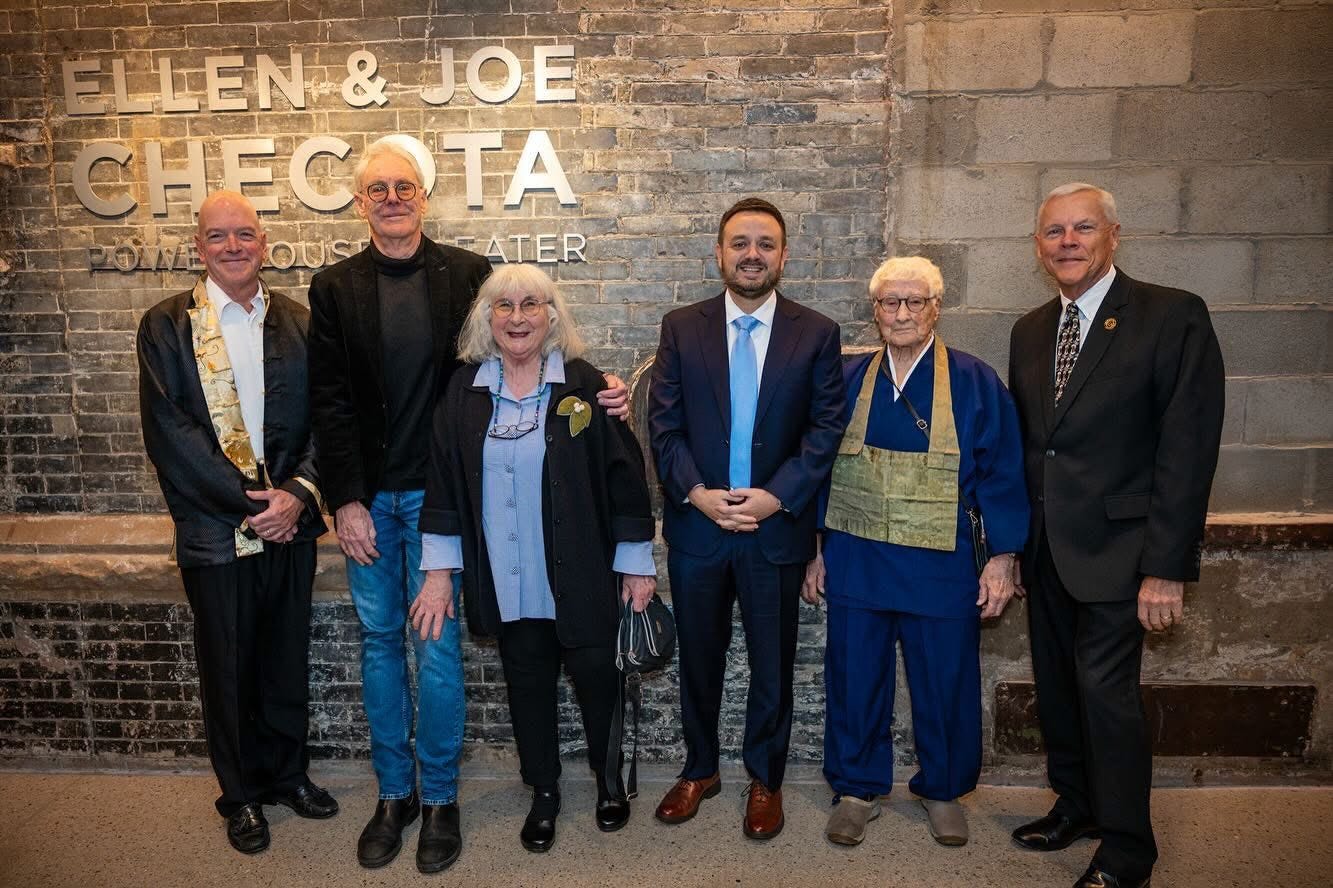
Pictured above are Milwaukee Rep’s extraordinary previous leaders including former Artistic Director Joseph Hanreddy and former Managing Directors Tonen (Sara) O’Connor and Tim Shields at the opening of the Associated Bank Theater Center (2025).
A superb reflection, Chad. When I was beginning my career more than half a century ago, I started paying attention to the tenure of the leaders I admired. I noticed that successful nonprofit CEOs stayed an average of seven years. (I have a tongue-in-cheek explanation which I'd be pleased to share in another context.) I reached 22 years, three administrative lifetimes, at my last position only because I had taken the organization through three distinct stages in its life-cycle. But I suddenly found myself resisting change, and that's when I knew it was time to find something new.
Well said. On a related note, I feel Board members face the same questions. I served on the Arena Stage Board for 23 years. At the time it had no term limits. It was a prestigious role (I served as Chair for 3 1/2 years), and I made great friends among other Board members, theater leadership and artists that I value. But there came a time when I realized that everyone knew the issues that were important to me (strong marketing, great research, advocating for younger audiences). If I made a mark on the organization, these values could be achieved without me. And I recognized that just as new audiences were important, so were refreshed ideas from new Board members. It may have taken some time, but I knew it was time to move on.